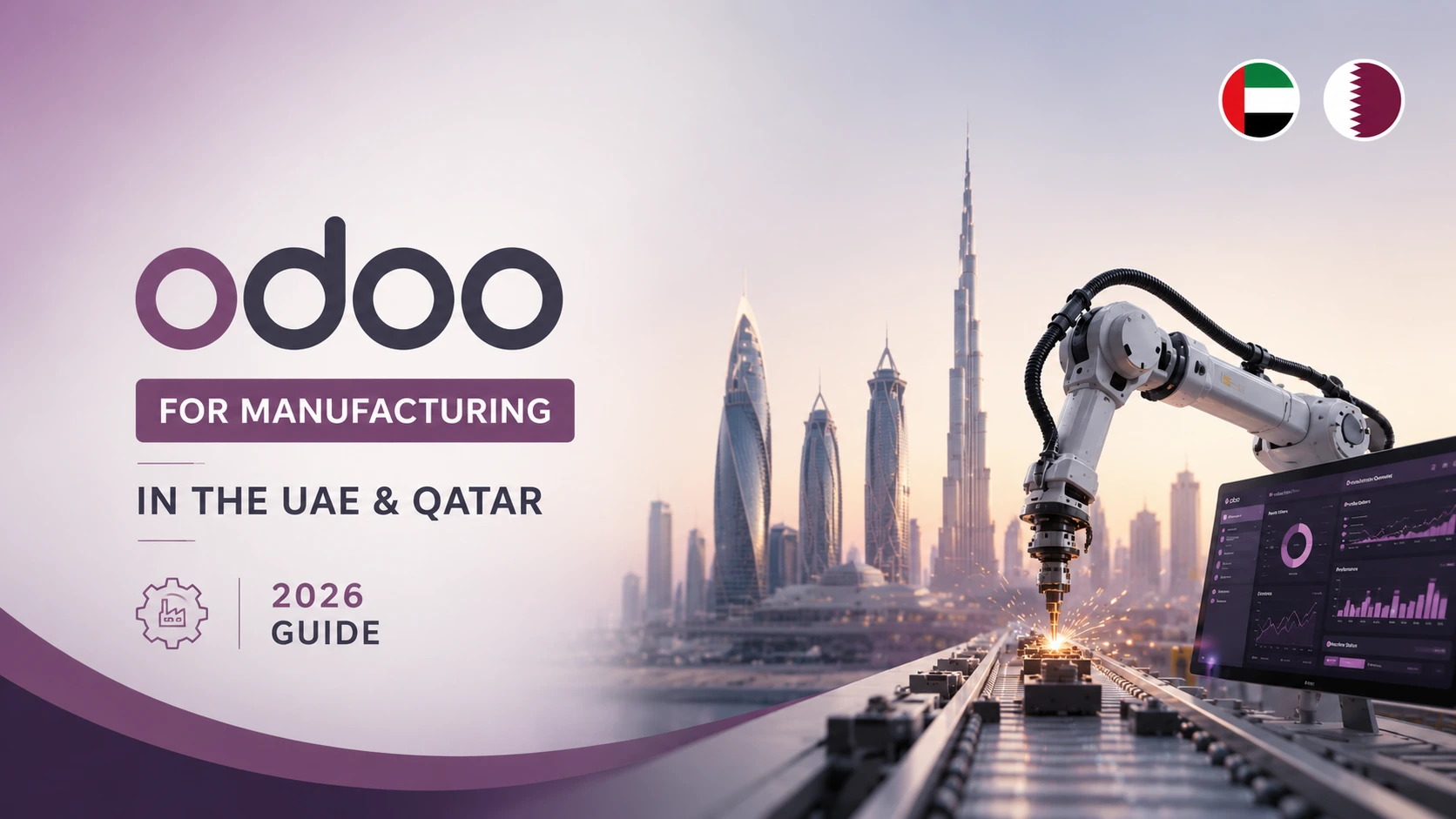
The GCC’s factories are modernizing fast. National strategies like the UAE’s “Operation 300bn” industrial drive and Qatar’s economic diversification under its National Vision are pushing manufacturers to produce more, waste less, and prove compliance at every step. Yet a surprising number of plants across the UAE and Qatar still run on a patchwork of spreadsheets, standalone accounting software, and disconnected shop-floor notes. That’s exactly the gap Odoo for manufacturing closes — connecting planning, production, quality, inventory, and finance in one real-time system.
This guide is a complete, practical look at Odoo for manufacturing in the UAE and Qatar in 2026: why regional manufacturers are switching, the core modules and how they fit together, local compliance considerations, realistic costs, and the pro tips that separate a smooth rollout from a stalled one.
Why GCC Manufacturers Are Choosing Odoo in 2026?
Manufacturing in the Gulf is no longer just about output — it’s about visibility, traceability, and compliance. Five forces are driving the shift to Odoo for manufacturing this year:
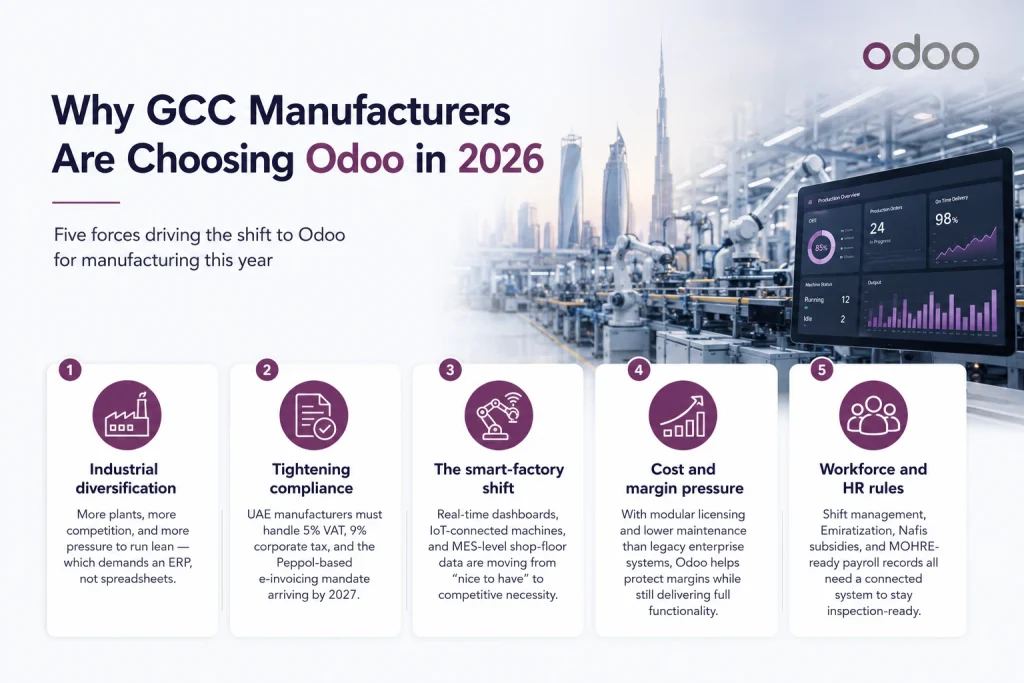
- Industrial diversification. Government strategies to grow non-oil manufacturing mean more plants, more competition, and more pressure to run lean — which demands an ERP, not spreadsheets.
- Tightening compliance. UAE manufacturers must handle 5% VAT, 9% corporate tax, and the Peppol-based e-invoicing mandate arriving by 2027. Audit-ready data isn’t optional anymore.
- The smart-factory shift. Real-time dashboards, IoT-connected machines, and MES-level shop-floor data are moving from “nice to have” to competitive necessity.
- Cost and margin pressure. With modular licensing and lower maintenance than legacy enterprise systems, Odoo helps protect margins while still delivering full functionality.
- Workforce and HR rules. Shift management, Emiratization, Nafis subsidies, and MOHRE-ready payroll records all need a connected system to stay inspection-ready.
What Manufacturing Without an ERP Really Looks Like?
If your plant doesn’t run on a unified system, the symptoms are familiar. Inventory lives in one database, production in another, and quality metrics on spreadsheets that never quite match. Planners build schedules by hand, so a single missed update cascades into chaos on the floor. Nobody has an instant, accurate view of stock, work-in-progress, or finished goods, which makes agile decisions impossible.
The result is predictable: material shortages that halt lines, overstock that ties up cash, defects caught after shipping rather than on the floor, and month-end numbers that take days to reconcile. None of these are software problems — they’re disconnection problems. And disconnection is exactly what an integrated manufacturing ERP is built to eliminate.
5 Signs Your Factory Has Outgrown Spreadsheets
If three or more of these ring true, your operation is ready for Odoo for manufacturing:
- Production schedules are built and updated manually.
- Stock figures and physical counts regularly disagree.
- Quality issues surface after products ship, not during production.
- You can’t see real-time work-in-progress or machine utilization.
- Compliance (VAT, corporate tax, e-invoicing) is a recurring scramble.
The Odoo Manufacturing Stack: Core Modules
Odoo’s strength is that production doesn’t sit in a silo — it’s wired into inventory, purchasing, quality, maintenance, and accounting. Here are the modules that matter most for a manufacturer:
| Module | What It Does |
|---|---|
| MRP / Manufacturing | Bills of materials, routings, work orders, and automatic production scheduling |
| Master Production Scheduling (MPS) | Plans production against forecast demand, capacity, and material availability |
| Inventory | Real-time multi-location stock, barcode workflows, lot/serial traceability |
| Quality | QC checkpoints, alerts, and evidence capture on the shop floor |
| Maintenance | Preventive and corrective maintenance to cut unplanned downtime |
| Purchase | Automated reordering tied to real production needs |
| PLM & Subcontracting | Engineering change management and outsourced production control |
| Accounting | Real costing, variance tracking, VAT, and corporate-tax-ready reporting |
How the Modules Work Together?
The magic is in the connections. A sales order or demand forecast feeds the MPS, which checks stock and capacity, then generates manufacturing orders. Those orders pull materials from inventory (triggering automatic purchase requests when stock runs low), route work through the right work centers, and prompt quality checks at defined points. Maintenance schedules keep machines available, while every movement and consumption posts straight to accounting for accurate, real-time costing.
Because it all lives in one database, a planner, a floor supervisor, and a finance manager are looking at the same numbers at the same moment. No re-keying, no version conflicts, no end-of-month archaeology.
Pro tip: Don’t try to switch on every module at once. Start with MRP, Inventory, Purchase, and Accounting, get your team comfortable, then add Quality, Maintenance, and PLM in phases. This lowers risk, cost, and disruption.
Odoo Manufacturing in the UAE & Qatar: The Local Fit
Regional manufacturers have compliance and workforce requirements that a generic setup won’t satisfy out of the box. This is where local configuration matters:
- Tax & e-invoicing: 5% VAT and 9% corporate tax handled in accounting, with readiness for the UAE’s Peppol PINT AE e-invoicing mandate by 2027.
- Traceability & audit: Lot/serial tracking and embedded quality records keep you audit-ready for regulators and customers alike.
- HR & payroll: Shift management, attendance, and payroll configured for MOHRE inspections, Emiratization targets, and Nafis subsidies.
- Multi-entity: Multi-company, multi-warehouse, and multi-currency support for groups operating across the UAE, Qatar, and beyond.
If compliance is your trigger, our guides to Odoo implementation cost in the UAE and UAE e-invoicing and corporate tax are useful companions to this one.
Where Odoo Wins — and Where to Be Realistic?
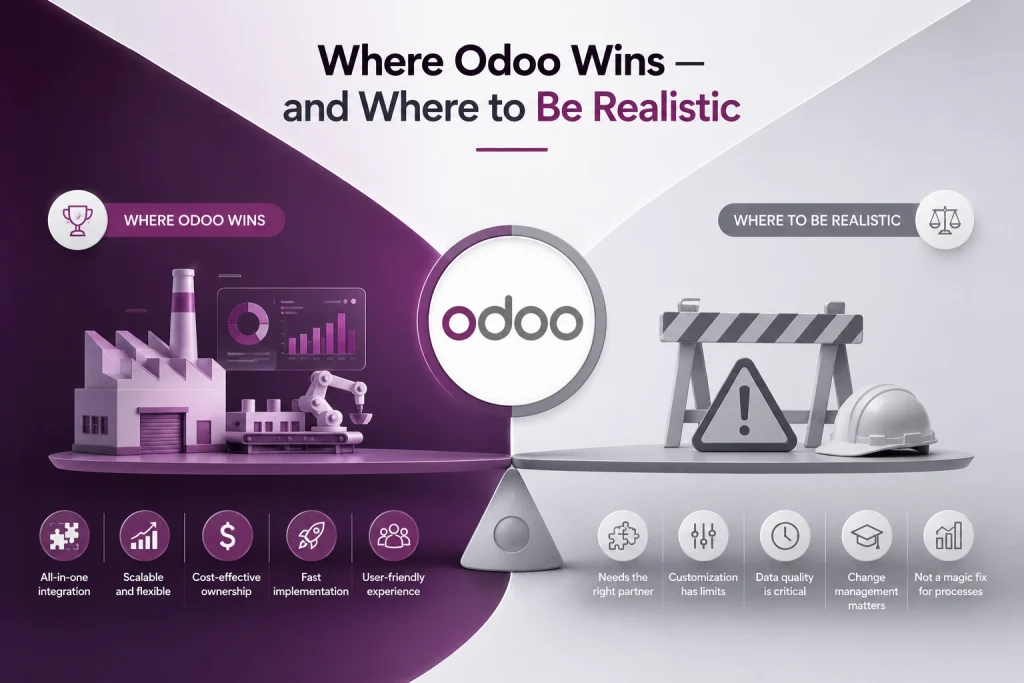
For the vast majority of discrete and light-process manufacturers, metal fabrication, food and beverage, building materials, plastics, electronics assembly, furniture, Odoo covers the full production lifecycle beautifully at a fraction of legacy-ERP cost. Its modular, all-in-one design is a genuine advantage.
Be realistic, though, about the edges. Extremely complex continuous-process manufacturing (think large-scale chemicals or pharma with deep batch-genealogy and validation needs) may require specialized add-ons or careful customization. The right answer is an honest fit assessment before you commit — not a forced fit in either direction.
Watch-out: Over-customizing on day one is the classic manufacturing-ERP trap. Adopt Odoo’s standard workflows first; customize only where your process is genuinely unique.
Odoo for Manufacturing by the Numbers
Realistic 2026 planning figures for manufacturers:
- Licensing: Odoo MRP starts low — around $25/month for a limited online version, with fully featured plans from roughly $95/month for 5 users; enterprise pricing is tailored to your needs.
- Implementation: most manufacturing ERP deployments run 3–9 months with an experienced partner, depending on scope and complexity.
- TCO: modular platforms like Odoo are reported to deliver 20–40% lower total cost of ownership than traditional enterprise ERP.
- ROI: manufacturers typically see returns within 12–18 months through better planning, less waste, and higher inventory accuracy.
Comparing Odoo against the bigger names? See our breakdown of Odoo vs SAP vs NetSuite vs Dynamics 365 for mid-market manufacturers.
Pro Tips for a Successful Manufacturing ERP Project
- Map your real processes first. Document how production actually flows before configuring anything.
- Clean your BOMs and item master. Garbage data in means garbage schedules out — fix it before go-live.
- Phase the rollout. Core modules first, advanced ones later, to manage risk and adoption.
- Train the shop floor, not just the office. Adoption fails when operators are an afterthought.
- Choose a partner who knows manufacturing and GCC compliance. Both matter; one without the other leaves gaps.
For more on avoiding the common pitfalls, read why most ERP projects fail and how to be in the 25%.
Common Questions, Answered Fast
1. Is Odoo good for manufacturing companies?
Yes. Odoo for manufacturing covers MRP, MPS, quality, maintenance, inventory, and costing in one connected system, suiting small plants up to multi-site industrial groups.
2. How long does Odoo manufacturing implementation take?
Most deployments take 3–9 months with an experienced partner, depending on the number of modules, sites, and customizations involved.
3. Can Odoo handle UAE and Qatar manufacturing compliance?
Yes. With local configuration, Odoo manages 5% VAT, 9% corporate tax, Peppol e-invoicing readiness, lot/serial traceability, and MOHRE-ready HR and payroll.
4. Does Odoo support shop-floor and IoT data?
Yes. Odoo integrates with IoT devices and MES-level workflows to capture real-time production data and connect the shop floor to planning and finance.
5. How much does Odoo for manufacturing cost?
Licensing starts around $25/month (limited) and from about $95/month for 5 users on fully featured plans, plus implementation and support. Modular adoption keeps initial costs down.
Build a Smarter Factory With Odoo
From the first work order to audit-ready financials, Odoo for manufacturing gives UAE and Qatar producers the visibility and control modern operations demand — without the price tag of legacy ERP. We’ve helped clients consolidate systems and automate workflows with measurable results; explore our client success stories and implementation methodology.
Book a free manufacturing ERP assessment — we’ll map your production processes, compliance needs, and the right Odoo setup for your plant.