
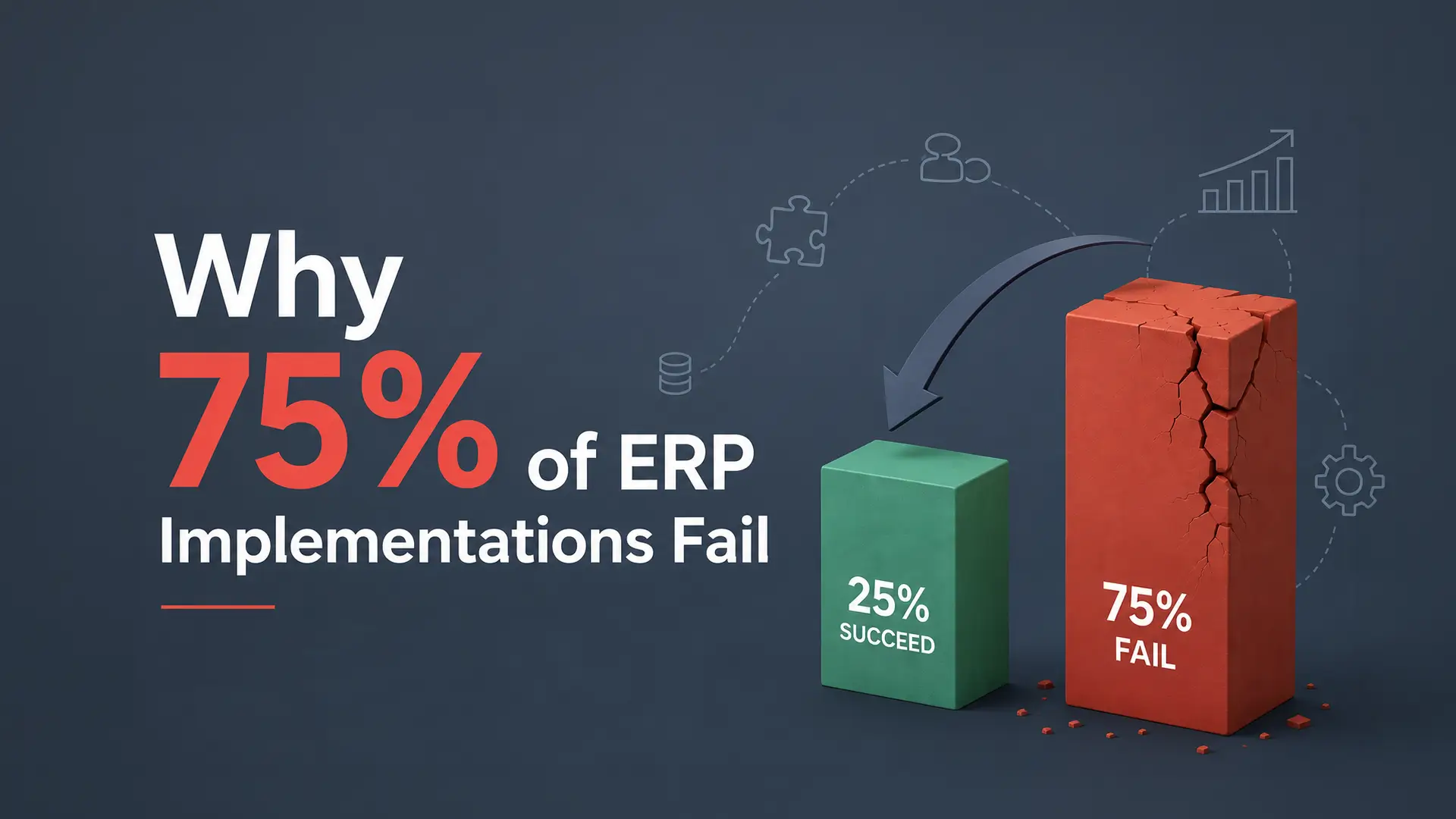
An ERP implementation can transform a business — or quietly drain its budget, time, and morale. The uncomfortable truth: research from Gartner and Panorama Consulting consistently shows that 55–75% of ERP projects fail to meet their original objectives. Yet the companies that get it right report dramatic gains. The difference almost always comes down to a handful of predictable, avoidable mistakes. Here’s why most ERP implementation projects fail — and exactly how to land in the successful 25%.
Quick Answer: Top Reasons ERP Implementations Fail
| Failure Cause | The Fix |
|---|---|
| Treated as an IT project, not a business change | Lead with process design and clear goals |
| Underestimated data migration | Audit and budget data early |
| Over-customization | Use standard configuration first |
| Weak change management | Invest in training and user adoption |
| Wrong partner / license-first selection | Choose an experienced, independent partner |
| No budget contingency | Reserve 15–25% for the unexpected |
How Often Do ERP Implementations Actually Fail?
The statistics are sobering. Gartner research indicates that more than 70% of ERP implementations fail to reach their original business-case goals, and failure rates can exceed 75%. Budget and schedule overruns are common — historically, over half of projects exceed budget and around 60% run past schedule.
But here’s the other side: when done right, the same research shows 97% of organizations report improvements, and roughly 81% meet their ROI expectations a year or more after go-live. ERP doesn’t fail because the software is bad — it fails because of how the project is run.
The Real Reasons ERP Implementation Projects Fail
1. Treating ERP as an IT project, not a business transformation
The single biggest mistake. Organizations that design their processes before configuring software achieve far better outcomes. ERP is a business change that happens to involve technology — not the other way around.
2. Unclear requirements and poor planning
Vague goals lead to scope creep. Around 35% of budget overruns trace back to expanding the initial project scope mid-flight. Without a documented, prioritized requirements list, the project drifts.
3. Underestimating data migration
Roughly half of organizations significantly underfund data migration. Messy, inconsistent legacy data is one of the most common reasons go-lives slip and budgets blow up. Audit your data before you scope the project.
4. Over-customization
Only about 7% of companies use ERP as-is, so some configuration is normal — but heavy custom code is where costs spiral. Excessive customization can inflate timeline and budget by 50% or more and creates long-term maintenance headaches.
5. Weak change management and low user adoption
A perfectly configured system fails if people don’t use it. User-adoption failure is often more expensive than the implementation itself. Training and communication aren’t optional extras — they’re core to success.
6. Choosing the wrong partner
License-first vendors optimize for the sale, not your long-term fit. Businesses that engage an experienced implementation partner achieve success rates around 85%. The right partner prioritizes architectural fit over selling you more modules.
7. Inadequate budget and resource planning
Underestimating internal staffing accounts for nearly 38% of overruns. Teams forget to account for their own people’s time — and skip the contingency reserve every project eventually needs.
The Cost of Getting It Wrong
Failed or troubled ERP projects routinely overshoot budgets by 50% or more, with some analyses citing average overruns far higher. Beyond money, the hidden costs are brutal: lost productivity, frustrated staff, delayed decisions, and a system nobody trusts. For a realistic budget baseline, see our guide to Odoo implementation cost.
How to Be in the 25%? The ERP Implementation Success Playbook
- Define clear goals and design processes first — before touching software.
- Secure executive sponsorship — 77% of successful companies cite leadership support as the top success factor.
- Choose an experienced, independent partner — fit over license sales.
- Audit and plan data migration early — clean data before you move it.
- Limit customization — adopt standard best-practice workflows wherever possible.
- Invest in change management and training — drive real user adoption.
- Build a contingency reserve — 15% for standard projects, 20–25% for complex ones.
- Phase the rollout and test thoroughly — reduce risk with controlled go-lives.
- Measure value after go-live — treat go-live as the start of value, not the finish line.
Why Odoo Lowers Implementation Risk?
Modern, modular ERPs reduce many of the classic failure triggers. Odoo’s phased, app-by-app approach means you can go live on core modules fast and expand later — avoiding the “big bang” risk. Its flexibility reduces the need for heavy custom code, and modern cloud ERPs can deliver measurable value in as little as nine months. Lower cost and faster time-to-value mean smaller, safer projects — and a much better shot at the successful 25%. If you’re still comparing platforms, see our breakdown of Odoo vs SAP vs NetSuite vs Dynamics 365.
How Odoova De-Risks Your ERP Implementation?
Our delivery approach is built around the success factors above — process-first design, clean data migration, minimal customization, and strong user adoption. See our implementation methodology and the results in our client success stories, including a database consolidation that cut redundancy and a workflow automation that saved a team 15 hours a week.
Frequently Asked Questions
1. What percentage of ERP implementations fail?
Gartner and Panorama Consulting report that 55–75% of ERP projects fail to meet their original objectives, though most organizations that follow best practices realize strong ROI within a few years.
2. What is the number one reason ERP implementations fail?
Treating ERP as a technology project rather than a business transformation. Skipping process design and change management is the most common root cause of failure.
3. How can I reduce the risk of ERP implementation failure?
Define clear goals, choose an experienced partner, plan data migration early, limit customization, invest in training, and keep a 15–25% contingency reserve.
4. Does choosing Odoo reduce failure risk?
It can. Odoo’s modular, phased approach and lower customization needs reduce scope and budget risk, enabling faster, safer go-lives compared with monolithic “big bang” projects.
Conclusion: Failure Is Avoidable
ERP implementation failure isn’t bad luck — it’s the predictable result of skipping the fundamentals. Companies that plan well, choose the right partner, manage change, and budget realistically consistently land in the successful 25%. The software matters far less than the discipline behind the project.
Planning an ERP project and want to stack the odds in your favor? Talk to our team for a no-obligation implementation review — and start your project the right way.