UAE e-invoicing is no longer a future concern — it’s a legal countdown. With mandatory go-live set for 1 January 2027 and the deadline to appoint an Accredited Service Provider (ASP) now 30 October 2026, businesses running Odoo need to act this year. This guide explains the UAE e-invoicing and corporate tax rules in plain language, and shows exactly how to make Odoo compliant before the deadlines hit.
Disclaimer: This article is for general information only and is not legal or tax advice. Always confirm your obligations with the UAE Ministry of Finance, the Federal Tax Authority (FTA), or a qualified tax advisor.
Quick Answer: UAE E-Invoicing Key Dates
| Milestone | Date |
|---|---|
| Pilot phase begins | 1 July 2026 |
| ASP appointment deadline (revenue ≥ AED 50M) | 30 October 2026 |
| Mandatory go-live (revenue ≥ AED 50M) | 1 January 2027 |
| Businesses below AED 50M | From ~1 July 2027 |
| Business-to-Government (B2G) | From October 2027 |
The framework is governed by Ministerial Decisions 243 and 244 of 2025, with penalties set out in Cabinet Decision 106 of 2025. The takeaway: if your revenue exceeds AED 50 million, your runway is short.
What Is UAE E-Invoicing?
UAE e-invoicing replaces PDF and paper invoices with structured digital invoices exchanged through a government-approved network. The UAE has adopted the Peppol-based decentralised model (sometimes called the 5-corner model). Here’s how it works:
- Format: Invoices must be issued as structured XML compliant with the PINT AE (Peppol International Invoice – UAE) schema — not PDFs.
- Transmission: E-invoices are exchanged through a Ministry of Finance–approved Accredited Service Provider (ASP).
- Reporting: Invoice tax data is reported to the Federal Tax Authority (FTA) for compliance monitoring.
- Storage: E-invoices must be stored within the UAE.
Who Must Comply With UAE E-Invoicing?
The mandate applies broadly to businesses conducting B2B and B2G transactions in the UAE — whether VAT-registered or not — based on a Tax Identification Number (TIN). Free zone businesses are included unless specifically excluded. Business-to-Consumer (B2C) transactions are currently out of scope, but even B2C-heavy companies will need an ASP to receive supplier invoices once their phase begins.
Penalties for Non-Compliance
Cabinet Decision 106 of 2025 sets out gazetted administrative fines for e-invoicing violations — these are law, not estimates. Failure to issue compliant e-invoices, transmit through an ASP, or report data correctly can trigger penalties and operational disruption (rejected invoices, delayed payments). Early, accurate system integration is the best protection.
UAE Corporate Tax: What You Need to Know?
Alongside e-invoicing, the UAE corporate tax regime (Federal Decree-Law No. 47 of 2022, effective for financial years starting on or after 1 June 2023) reshaped compliance. The essentials:
| Rule | Rate / Detail |
|---|---|
| Taxable income up to AED 375,000 | 0% |
| Taxable income above AED 375,000 | 9% |
| Qualifying Free Zone Person (QFZP) | 0% on qualifying income, 9% on the rest |
| Large MNEs (global revenue ≥ €750M) — DMTT | 15% minimum effective rate |
| Small Business Relief (revenue ≤ AED 3M) | 0% election, available until 31 Dec 2026 |
| VAT (standard) | 5% |
Corporate tax returns are filed via the EmaraTax portal and are due within 9 months of the financial year-end. Note: even 0%-rated and free zone entities must register and file. Accurate, well-structured accounting data is now essential — which is exactly where a properly configured ERP earns its keep.
How to Make Odoo Ready for UAE E-Invoicing & Corporate Tax?
Odoo is well-suited to UAE compliance because its accounting engine produces clean, structured transaction data and integrates with external services. Making Odoo compliant comes down to configuration and the right ASP connection:
- Use a supported Odoo version with the UAE localization (VAT, TRN, Arabic invoice fields, FTA audit file).
- Configure tax codes and your TRN/TIN correctly across all companies and branches.
- Map your invoice data to the PINT AE XML schema so every required field is captured at source.
- Connect Odoo to an accredited, Peppol-certified ASP via API/connector so invoices transmit automatically through the network.
- Run end-to-end tests during the pilot phase to validate XML output and reduce rejection rates.
- Configure corporate tax & VAT reporting so financial statements and FTA filings are accurate and auditable.
- Train your finance team so the new workflow feels seamless — no separate portal, no manual re-keying.
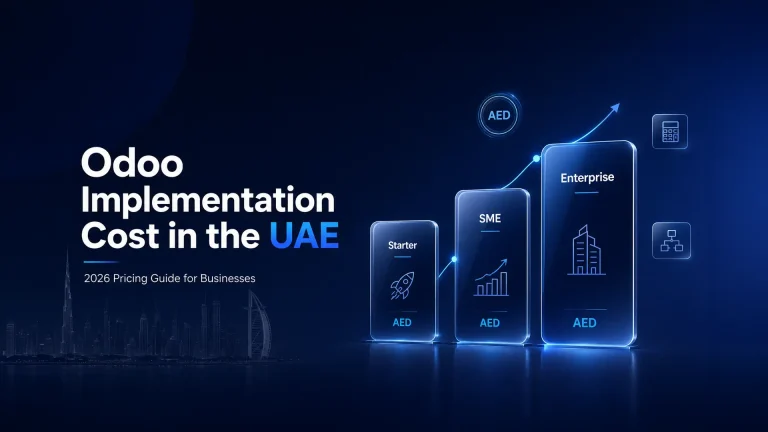
Done right, compliance becomes invisible: your team keeps invoicing as normal in Odoo, while the structured XML flows to the ASP and the FTA in the background. For budgeting this work, see our breakdown of Odoo implementation cost in the UAE.
Why You Should Act Now — Not in October?
The 30 October 2026 ASP deadline is a milestone, not a starting line. Proper implementation — configuration, mapping, ASP integration, testing, and training — takes weeks to months for a mid-sized business. Companies that wait risk rushed setups, higher invoice rejection rates, and last-minute costs. Starting in 2026 is not early; it’s necessary.
How Odoova Helps You Get Compliant?
We configure Odoo for UAE VAT, corporate tax, and Peppol e-invoicing end to end — including ASP integration and team training — so you’re ready well before the deadline. Our clients have automated complex finance workflows with measurable results: a services firm cut 15 hours a week of manual work through payment automation, and others consolidated systems for cleaner reporting — explore our client success stories. Considering your options? Our comparison of leading ERPs can help, too.
Frequently Asked Questions
1. When does UAE e-invoicing become mandatory?
For businesses with annual revenue of AED 50 million or more, go-live is 1 January 2027, with an ASP appointed by 30 October 2026. Smaller businesses follow from around July 2027.
2. Do free zone companies need to comply?
Yes. Free zone businesses are included in the e-invoicing mandate unless specifically excluded, and must register and file for corporate tax even if they qualify for 0% on qualifying income.
3. Can Odoo handle UAE e-invoicing?
Yes. With the UAE localization, correct tax configuration, and an accredited Peppol-certified ASP connector, Odoo can produce PINT AE–compliant XML invoices and transmit them through the approved network.
4. Do I need an Accredited Service Provider (ASP)?
Yes. Only MoF-approved, Peppol-certified ASPs have direct system connectivity. Your ERP connects to the e-invoicing network through an ASP — it’s a core compliance partner, not just a vendor.
5. Are B2C transactions included?
B2C transactions are currently out of scope, but you’ll still need an ASP to receive supplier invoices once your phase begins, so preparation is still required.
Conclusion: Get Ahead of the UAE E-Invoicing Deadline
UAE e-invoicing and corporate tax compliance are now business-critical. The companies that prepare their Odoo systems in 2026 — configuring localization, connecting an ASP, and testing early — will glide through the 2027 go-live while others scramble. With gazetted fines and fixed deadlines, the cost of waiting is real.
Want to know exactly where your business stands? Book a free UAE compliance readiness check and we’ll assess your Odoo setup, your applicable phase, and a clear path to full compliance — before the deadline.