Running an eCommerce business looks exciting from the outside. Orders come in. Customers keep shopping. Sales numbers grow.
But behind every successful online store is a complex operation involving inventory management, customer support, accounting, shipping, marketing, product updates, warehouse coordination, and data tracking.
As businesses scale, these operations quickly become difficult to manage manually.
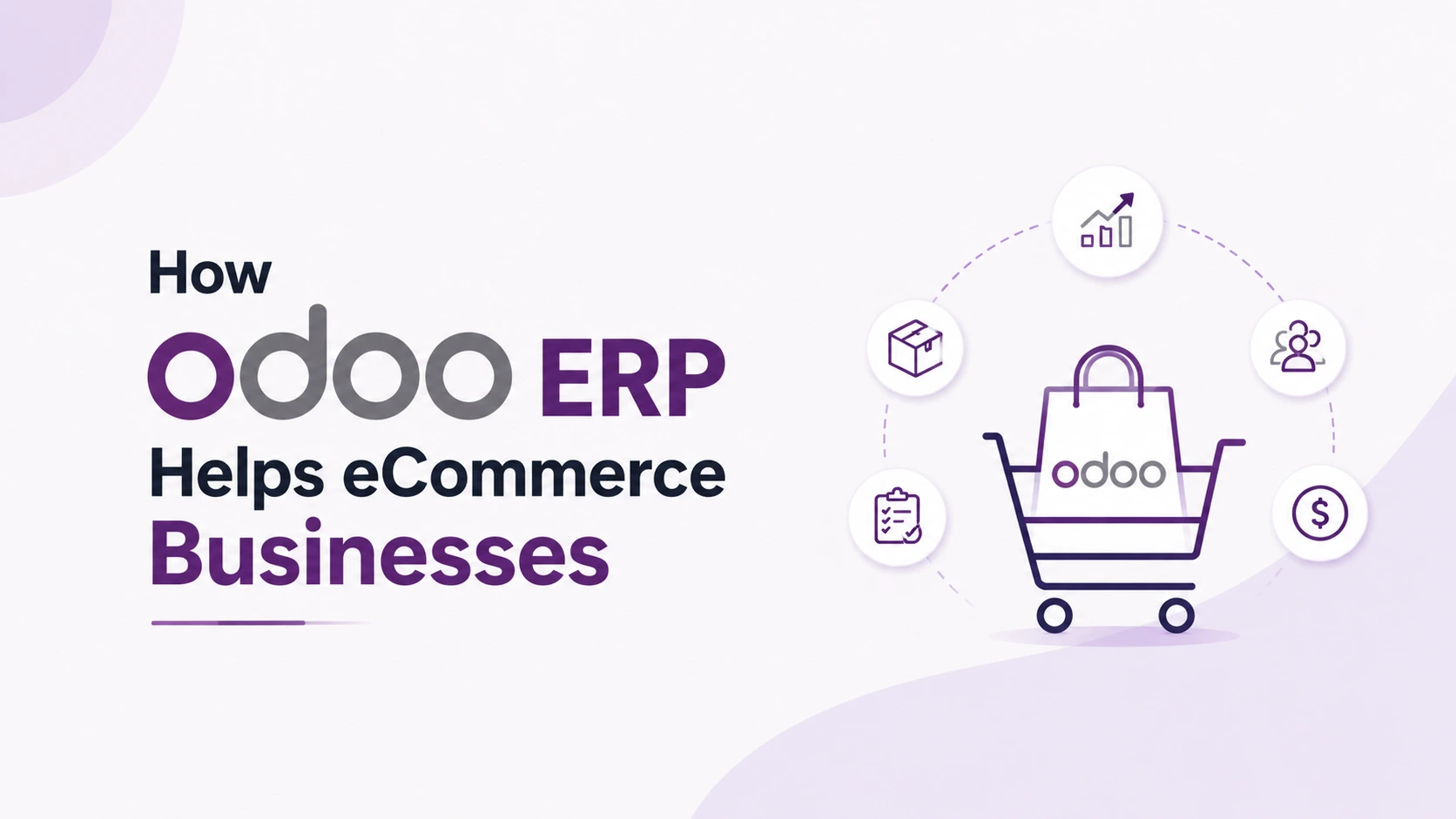
This is the stage for How Odoo ERP Helps eCommerce Businesses Grow Faster where many eCommerce businesses begin facing problems like:
- Inventory mismatches
- Delayed deliveries
- Order management chaos
- Customer complaints
- Accounting inaccuracies
- Disconnected software systems
And the bigger the business grows, the bigger these problems become.
That’s why modern eCommerce brands are increasingly adopting ERP systems like Odoo.
Odoo ERP helps businesses centralize operations, automate repetitive tasks, improve customer experiences, and make smarter business decisions using real-time data.
Whether you run a small Shopify store, a multi-vendor marketplace, or a large enterprise eCommerce operation, Odoo can significantly improve efficiency and scalability.
In this complete guide, you’ll learn exactly how Odoo ERP helps eCommerce businesses grow faster and why it has become one of the most popular ERP solutions worldwide.
What is Odoo ERP?
Odoo is an all-in-one ERP (Enterprise Resource Planning) software that integrates multiple business operations into one centralized platform.
Instead of using separate tools for inventory, accounting, CRM, customer support, sales, and marketing, Odoo combines everything in a unified ecosystem.
Core Odoo Modules for eCommerce
| Module | Purpose |
| eCommerce | Online store management |
| Inventory | Stock tracking & warehouse management |
| CRM | Customer relationship management |
| Accounting | Financial management & invoicing |
| Sales | Order processing & quotations |
| Purchase | Supplier management |
| Marketing Automation | Email & campaign automation |
| Helpdesk | Customer support |
| Shipping Integration | Delivery & logistics management |
One of Odoo’s biggest strengths is flexibility. Businesses can start with essential modules and expand later as operations grow.
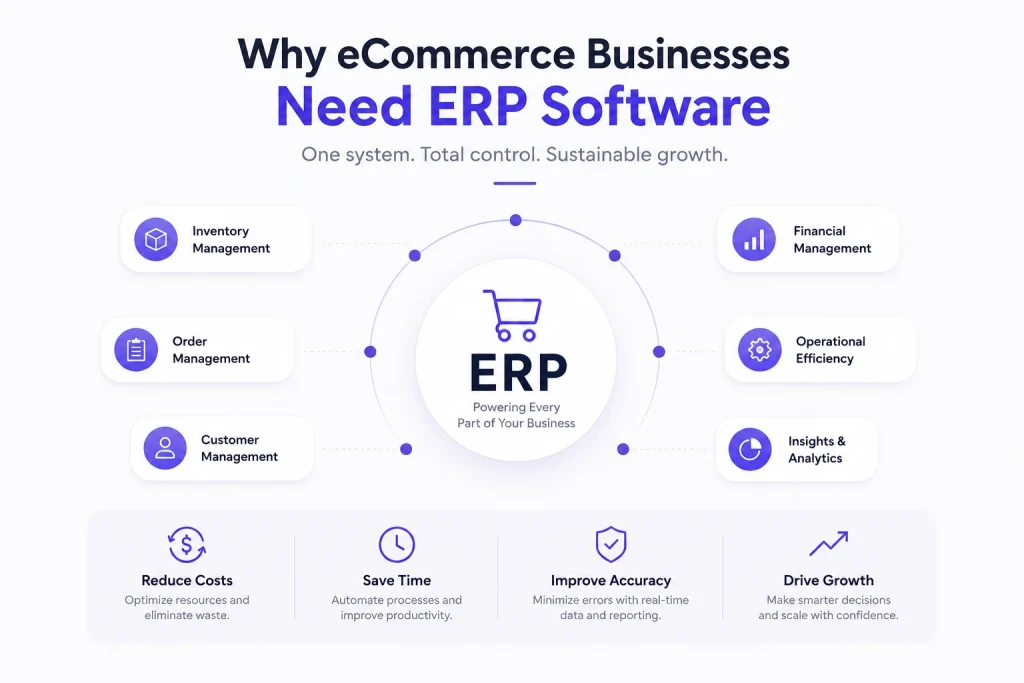
Why eCommerce Businesses Need ERP Software?
Most growing eCommerce businesses eventually reach a point where manual systems stop working efficiently.
For example:
- Inventory is updated manually in spreadsheets
- Accounting is handled separately
- Orders are processed through multiple tools
- Customer data is spread across platforms
- Marketing and sales teams use disconnected systems
This creates operational bottlenecks.
Common Problems Without ERP
| Challenge | Business Impact |
| Inventory mismatches | Overselling & stock shortages |
| Manual order processing | Delays & customer dissatisfaction |
| Disconnected software | Data inconsistency |
| Poor reporting visibility | Weak business decisions |
| Manual accounting | Increased financial errors |
| Multi-channel complexity | Operational inefficiency |
ERP software solves these issues by centralizing and automating operations.
How Odoo ERP Helps eCommerce Businesses?
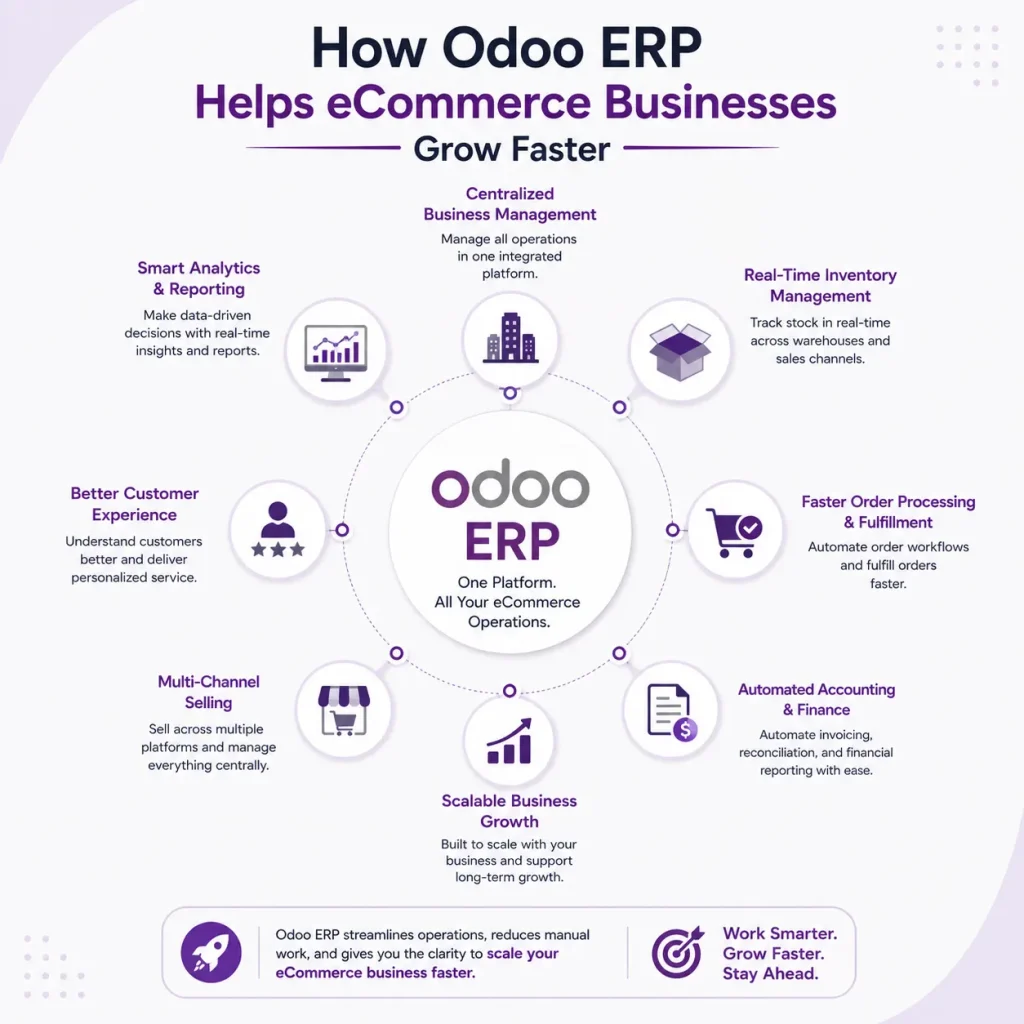
Centralized Business Management
One of the biggest operational challenges for eCommerce businesses is managing multiple systems simultaneously.
A business may use:
- One tool for inventory
- Another for accounting
- A separate CRM
- A different marketing platform
- Additional software for customer support
Managing disconnected systems wastes time and creates data inconsistencies.
Odoo eliminates this problem by bringing everything into one platform.
Benefits of Centralized Operations
| Benefit | Result |
| Unified business data | Better accuracy |
| Single dashboard management | Improved productivity |
| Real-time synchronization | Faster decision-making |
| Reduced manual work | Higher operational efficiency |
This centralized structure helps teams work faster and more efficiently.
Real-Time Inventory Management
Inventory management is one of the most important parts of eCommerce success.
Poor inventory tracking can result in:
- Overselling
- Delayed shipments
- Lost revenue
- Customer dissatisfaction
Odoo provides real-time inventory synchronization across all sales channels.
Key Inventory Features
- Multi-warehouse management
- Barcode scanning
- Batch tracking
- Serial number management
- Automated stock alerts
- Inventory forecasting
Example Workflow
| Event | Odoo Response |
| Customer places an order | Stock updates automatically |
| Inventory becomes low | Alert notification triggered |
| Returned item processed | Inventory adjusts instantly |
| New stock received | Quantities synchronize automatically |
This improves operational accuracy and customer satisfaction.
Faster Order Processing & Fulfillment
Customers expect fast delivery and real-time updates.
Manual order processing slows down fulfillment and increases operational mistakes.
Odoo automates the complete order workflow.
Automated Order Flow
- Customer places order
- Payment confirmed automatically
- Invoice generated instantly
- Inventory updated
- Warehouse receives notification
- Shipping process initiated
- Customer receives tracking updates
Business Impact
| Metric | Improvement |
| Order processing speed | Faster |
| Manual errors | Reduced |
| Fulfillment efficiency | Improved |
| Customer satisfaction | Higher |
Automation allows businesses to scale operations without increasing administrative workload.
Multi-Channel Selling Management
Modern eCommerce businesses rarely sell through a single platform.
Today’s brands often sell via:
- Websites
- Marketplaces
- Mobile apps
- Facebook Shops
- Instagram Shops
Managing inventory and orders across multiple platforms manually creates operational chaos.
Odoo centralizes all sales channels into one unified dashboard.
Benefits of Multi-Channel Integration
| Feature | Advantage |
| Unified inventory | Prevents overselling |
| Centralized order management | Faster operations |
| Shared customer database | Better customer insights |
| Combined analytics | Smarter decisions |
This helps businesses expand sales channels more confidently.
Better Customer Relationship Management (CRM)
Customer retention is one of the biggest drivers of long-term profitability.
Acquiring new customers is expensive. Retaining existing customers is significantly more cost-effective.
Odoo CRM helps businesses:
- Track customer interactions
- Manage leads
- Automate follow-ups
- Personalize communication
- Improve customer support
CRM Features
- Customer segmentation
- Email automation
- Lead tracking
- Sales pipelines
- Follow-up reminders
- Customer activity history
This creates stronger customer relationships and improves repeat purchases.
Automated Accounting & Financial Management
Accounting becomes increasingly difficult as order volumes grow.
Manual bookkeeping increases the risk of:
- Invoice errors
- Tax mistakes
- Financial inconsistencies
- Delayed reporting
Odoo automates financial management processes.
Accounting Features
| Feature | Benefit |
| Automated invoicing | Saves time |
| Expense management | Better budgeting |
| Tax automation | Improved compliance |
| Bank reconciliation | Reduced errors |
| Financial reporting | Better visibility |
This improves financial accuracy and reduces administrative workload.
Smart Analytics & Reporting
Successful eCommerce businesses rely heavily on data.
Without proper analytics, businesses struggle to understand:
- Best-selling products
- Customer behavior
- Revenue trends
- Inventory performance
- Marketing ROI
Odoo provides real-time dashboards and reporting tools.
Important Reports in Odoo
- Sales reports
- Customer analytics
- Inventory valuation
- Profitability analysis
- Marketing performance reports
- Revenue tracking
Why Analytics Matter?
Businesses using real-time analytics can make faster and more informed decisions.
This directly impacts:
- Profitability
- Operational efficiency
- Inventory planning
- Marketing effectiveness
Odoo ERP vs Traditional Software Systems
| Feature | Traditional Software Systems | Odoo ERP |
| System Structure | Multiple disconnected tools | Fully integrated platform |
| Data Management | Limited centralized data | Real-time centralized data |
| Reporting & Analytics | Basic or delayed reports | Advanced real-time analytics |
| Automation Capabilities | Low automation | High workflow automation |
| Scalability | Difficult to scale | Easily scalable for growth |
| Customization Options | Expensive and limited | Flexible and customizable |
| Multi-Channel Selling | Limited support | Strong multi-channel integration |
| Inventory Synchronization | Mostly manual updates | Automated real-time updates |
| Customer Relationship Management | Separate CRM tools required | Built-in CRM system |
| Operational Efficiency | Slower workflows | Streamlined operations |
| Cost Efficiency | Higher long-term costs | More cost-effective |
| Business Visibility | Fragmented data visibility | Unified business insights |
eCommerce ERP Statistics & Industry Insights
ERP adoption continues to grow rapidly among eCommerce businesses.
Industry Statistics
| Statistic | Data |
| Global ERP market expected by 2030 | Over $100 billion |
| Businesses reporting improved productivity after ERP implementation | 95% |
| Inventory errors reduced using ERP | Up to 65% |
| Operational cost reduction | 20–30% |
| Faster order processing using automation | Up to 50% |
| Businesses improving customer service with ERP | 80% |
Expert Insight
“The future of eCommerce belongs to businesses that automate operations and centralize data.”
This is why ERP systems are becoming essential rather than optional.
Common Mistakes eCommerce Businesses Make Without ERP
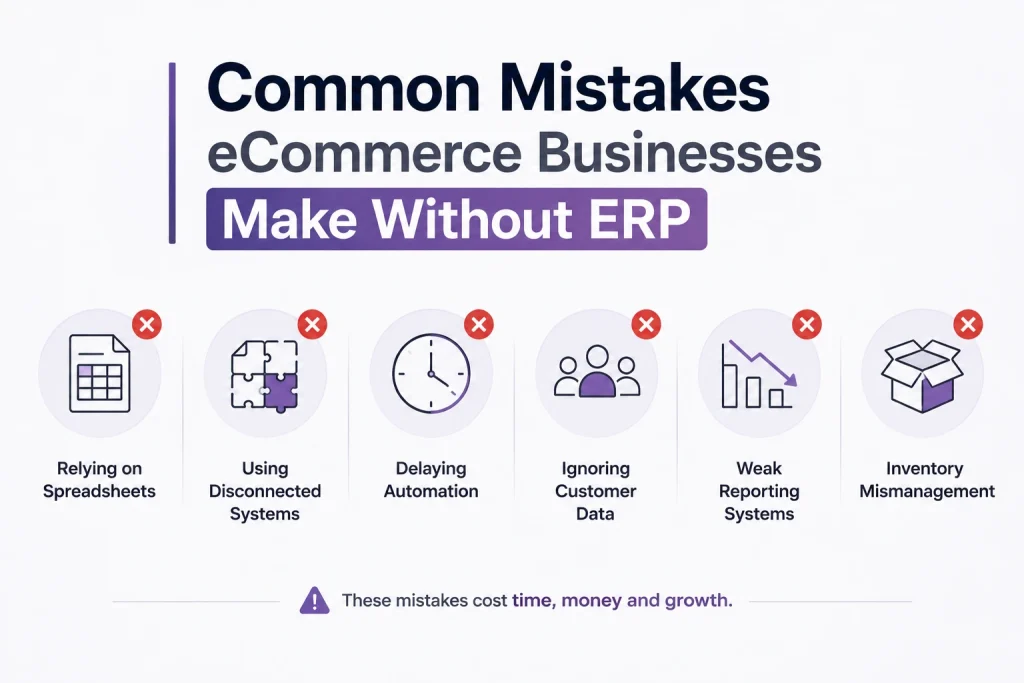
Many businesses delay ERP implementation until operational problems become severe.
Common Mistakes
1. Relying on Spreadsheets for Inventory
Manual inventory tracking often causes costly mistakes.
2. Using Multiple Disconnected Tools
Disconnected systems create inconsistent data.
3. Delaying Automation
Manual processes slow down scalability.
4. Ignoring Customer Data
Businesses lose valuable insights without centralized CRM systems.
5. Weak Reporting Systems
Poor reporting limits strategic decision-making.
Best Practices for Successful Odoo ERP Implementation
Successful ERP implementation requires planning and strategy.
1. Start with Core Modules
Begin with essential modules such as:
- Inventory
- Accounting
- Sales
- CRM
Then expand gradually.
2. Train Employees Properly
User adoption is critical for ERP success.
Invest in proper employee training.
3. Clean Existing Data
Remove duplicate or outdated records before migration.
4. Choose the Right Implementation Partner
An experienced Odoo implementation partner can customize the system based on business goals.
5. Automate Gradually
Avoid trying to automate every process immediately.
Start small and expand step-by-step.
Future of ERP in eCommerce
ERP technology is evolving rapidly.
Future trends include:
- AI-powered automation
- Predictive analytics
- Smart warehouse systems
- Personalized customer experiences
- Voice-enabled ERP systems
- IoT integration
Odoo continues expanding its AI and automation capabilities, making it increasingly powerful for modern businesses.
Are you looking to manage and grow your eCommerce business with automation? Odoo ERP helps businesses grow faster and operate more efficiently. We’re here to support you at every step of your business journey.
Frequently Asked Questions
1. Is Odoo ERP suitable for small eCommerce businesses?
Yes. Odoo is highly scalable and suitable for startups, small businesses, and large enterprises.
2. Can Odoo integrate with eCommerce platforms?
Yes. Odoo integrates with websites, payment gateways, shipping providers, and marketplaces.
3. Does Odoo help with inventory management?
Absolutely. Odoo provides real-time inventory tracking, warehouse management, barcode scanning, and stock forecasting.
4. Is Odoo ERP customizable?
Yes. One of Odoo’s biggest strengths is flexibility and customization.
5. How long does Odoo ERP implementation take?
Implementation time depends on business size and required modules. Small implementations may take weeks, while enterprise deployments may take several months.
Final Thoughts
eCommerce businesses today operate in a highly competitive environment where operational efficiency directly impacts profitability.
Manual processes and disconnected software systems slow growth, increase operational costs, and reduce customer satisfaction.
Odoo ERP helps businesses solve these challenges by centralizing operations, automating workflows, improving inventory management, and providing real-time business visibility.
Key Benefits of Odoo ERP
- Centralized operations
- Real-time inventory management
- Faster order fulfillment
- Improved customer experience
- Better analytics & reporting
- Automated accounting
- Scalable business growth
Businesses that invest in ERP systems today are better prepared for the future of eCommerce.