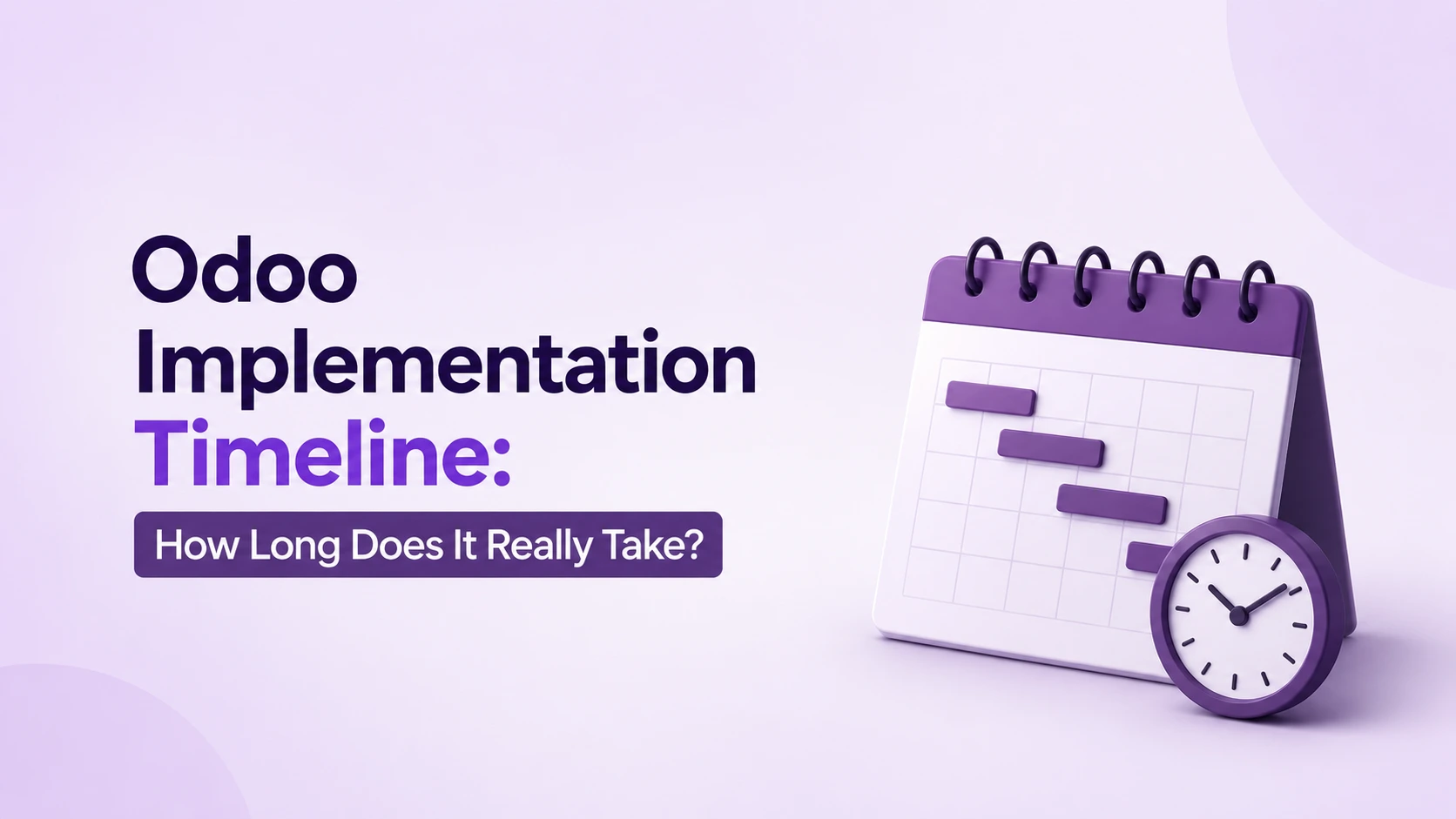
“How long will it take?” is the first question almost every business asks about a new ERP — and the honest Odoo implementation timeline answer is: it depends. But “it depends” is useless for planning, so let’s make it concrete. With a focused scope you can be live in a month; with a full enterprise rollout you’re looking at several. This guide gives you real 2026 ranges by business size, a phase-by-phase breakdown with durations, the factors that stretch or shrink the schedule, and a sample 12-week timeline you can plan against.
Understanding the Odoo implementation timeline upfront is the difference between a smooth, predictable project and a frustrating one that drifts. Let’s set realistic expectations.
The Short Answer: Typical Odoo Implementation Timelines
Here’s how durations break down by scope, assuming an experienced partner and a reasonably responsive internal team:
| Project Type | Scope | Typical Timeline |
|---|---|---|
| Quick Start | 2–3 core modules, <20 users, minimal customization | 4–8 weeks |
| SME / Mid-Market | 5–8 modules, 50–150 users, moderate customization | 12–16 weeks |
| Enterprise | 10+ modules, 200+ users, heavy customization & integrations | 20–28 weeks |
| Global / Complex | Multi-entity, multi-country, legacy migrations | 9–18 months+ |
The median mid-market project — the one most growing businesses fall into — runs about 12–16 weeks from kickoff to go-live.
The 6 Phases of an Odoo Implementation
Almost every successful project moves through the same six phases. Knowing how long each typically takes helps you spot delays early.
1. Discovery & requirements (1–3 weeks)
The team maps your current processes across sales, purchasing, inventory, accounting, and reporting, and defines what “success” looks like. Rushing this phase is the most common reason projects overrun later.
2. Design & configuration (2–4 weeks)
Your chart of accounts, taxes, workflows, users, and roles are set up in Odoo using standard features wherever possible. Enterprise builds with heavy architecture work can stretch this to a month or more.
3. Data migration (1–3 weeks)
Masters (customers, vendors, products) and historical transactions are cleaned, mapped, and imported. Messy legacy data is the single biggest cause of delay here.
4. Customization & integration (0 weeks to several months)
This is the most variable phase. Standard configuration adds little time; custom modules, bespoke automations, and third-party integrations (eCommerce, payment, logistics) can add 2–4 months for complex projects.
5. Testing, UAT & training (1–4 weeks)
You validate the system against real scenarios, fix issues, and train users by role. Skimping on training quietly sabotages adoption after go-live.
6. Go-live & hypercare (1–2 weeks + 1–2 months support)
The system goes live, often with a short period of intensive “hypercare” support to resolve real-world issues and fine-tune workflows.
What Actually Drives the Timeline?
Six variables explain almost every difference between a 6-week and a 6-month project:
- Scope. More modules, more users, and more integrations mean more time — the single biggest factor.
- Customization. Standard Odoo is fast; heavy custom development extends both build and testing.
- Data quality. Clean data imports quickly; messy data needs weeks of cleansing.
- Integrations. Each third-party connection adds discovery, build, and testing time.
- Decision speed. Slow internal sign-offs stall projects more than any technical issue.
- Partner experience. An experienced partner with a proven methodology compresses the whole timeline.
The #1 Timeline Killer: Dirty Data
If a project blows its schedule, the cause is usually hiding in the data. Duplicate customers, inconsistent product codes, half-finished records, and undocumented quirks from the old system all surface during migration — and each one needs investigating before it can be imported. Migrating poor-quality data isn’t just slow; it’s a leading cause of outright implementation failure.
Pro tip: Start cleaning your data the day you decide to implement — not when migration begins. It’s the one task you can do in parallel that directly shortens the critical path.
Phased vs Big-Bang: Which Is Faster — and Safer?
There are two ways to go live. A big-bang rollout switches everything on at once — fastest in theory, and fine for small businesses with simple needs, but high-risk if anything goes wrong. A phased rollout brings modules live in waves (say, accounting and inventory first, then manufacturing and HR), which spreads risk, eases adoption, and lets your team build confidence.
For most growing businesses — and almost all ERP newcomers — phased is the smarter choice. It may add a little calendar time, but it dramatically reduces the chance of a disruptive failure that costs far more than the time saved.
Watch-out: Schedule go-live for a Friday where possible. It gives your team the weekend as a buffer to resolve any teething issues before the first full business day.
How to Speed Up Your Odoo Implementation?
- Invest in discovery. A clear, prioritized scope prevents the rework that wrecks timelines.
- Name a decision-maker. One empowered internal owner who can approve quickly keeps momentum.
- Limit day-one customization. Go live on standard workflows; add the nice-to-haves later.
- Clean data early and in parallel. Don’t let migration wait on it.
- Free up your team’s time. Implementation needs real hours from your people — plan for it.
- Pick a partner with a methodology. Proven frameworks and AI-assisted tools shave weeks off delivery.
Odoo Implementation Timeline by the Numbers
The figures worth remembering: a focused Quick Start can go live in 4–8 weeks; the typical mid-market project takes 12–16 weeks; enterprise rollouts run 20–28 weeks; and discovery (1–3 weeks), data migration (1–3 weeks), and go-live (1–2 weeks) are fairly consistent regardless of size — it’s customization and integration that swing the total. Recent AI-assisted development tools and refined methodologies have made implementations faster than they were even a couple of years ago. For the cost side of the equation, see our Odoo implementation cost guide.
A Sample 12-Week Mid-Market Timeline
- Weeks 1–2: Discovery, process mapping, and scope sign-off.
- Weeks 3–5: Configuration of core modules, taxes, and user roles.
- Weeks 4–7: Data cleansing and migration (overlapping configuration).
- Weeks 6–9: Customizations, integrations, and report building.
- Weeks 9–11: Testing, UAT, and role-based training.
- Week 12: Go-live, followed by 4–8 weeks of hypercare support.
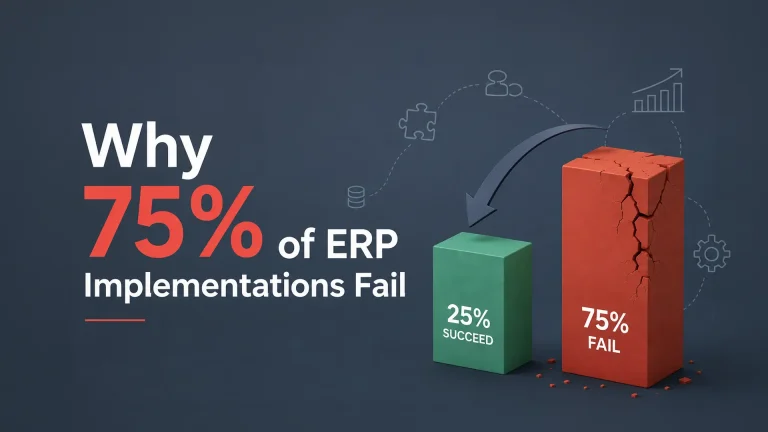
Notice how phases overlap — a good plan runs data work alongside configuration rather than strictly in sequence, which is how experienced partners keep the timeline tight. Avoiding the classic pitfalls matters too; see why most ERP projects fail and how to be in the 25%.
Common Questions, Answered Fast
1. How long does a small Odoo implementation take?
For 2–3 core modules and fewer than 20 users with minimal customization, expect 4–8 weeks — sometimes as fast as 3–5 weeks if your data is clean and decisions are quick.
2. What’s the typical timeline for a mid-sized business?
Most mid-market projects (5–8 modules, 50–150 users, moderate customization) take 12–16 weeks from kickoff to go-live.
3. Why do Odoo implementations get delayed?
The most common causes are messy data, scope creep, heavy customization, slow internal decisions, and skipping a proper discovery phase.
4. Is a phased or big-bang rollout faster?
Big-bang is faster on paper but riskier. Phased rollouts add a little time while dramatically lowering the risk of disruption — the better choice for most businesses.
5. Can I shorten the Odoo implementation timeline?
Yes — invest in discovery, clean data early, limit day-one customization, empower a decision-maker, and work with an experienced partner who uses a proven methodology.
Plan Your Odoo Timeline With Confidence
A realistic Odoo implementation timeline isn’t about going as fast as possible — it’s about going live cleanly, on schedule, with a team that’s ready. We build phased, predictable project plans with clear milestones and exit criteria. See our implementation methodology and client success stories for how we keep projects on track.
Book a free scoping call — tell us your modules, users, and goals, and we’ll give you a realistic timeline for your project.