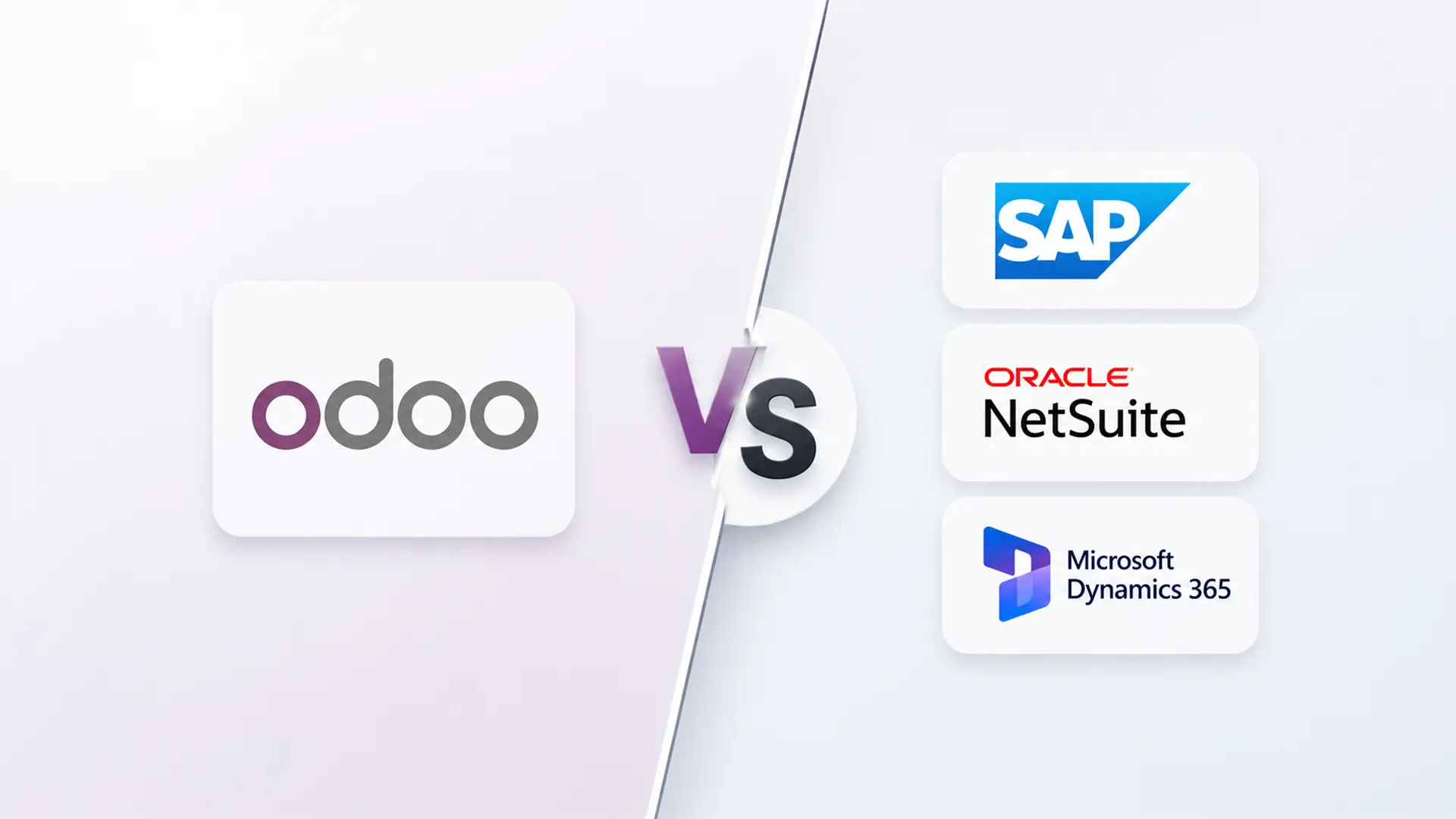
Choosing an ERP is one of the highest-stakes decisions a growing company makes — and the Odoo vs SAP vs NetSuite vs Dynamics 365 question sits at the center of almost every mid-market evaluation in 2026. Each platform has loyal customers and genuine strengths. This guide cuts through the marketing noise with a balanced, fact-based comparison so you can confidently pick the right ERP for your size, industry, and growth plans.
Quick Verdict: Which ERP Wins for Mid-Market?
| Platform | Best For | License (USD/user/mo) | 3-Yr TCO (50 users) |
|---|---|---|---|
| Odoo | Cost-conscious all-in-one, flexible customization | $13–31 (GCC ~$9–14) | $130K–220K |
| Dynamics 365 BC | Microsoft-stack companies | $70–110 | $250K–400K |
| NetSuite | Multi-entity, global, growth-stage | $99–199 + base fee | $350K–550K |
| SAP Business One | Manufacturing-heavy, traditional ERP | Premium (quote-based) | $300K–500K |
Short answer: Odoo delivers roughly 80% of the functionality of SAP and NetSuite at 40–60% of the total cost — making it the strongest value play for most mid-market businesses. But the right choice depends on your ecosystem, complexity, and growth path. Let’s break it down.
The Four Contenders at a Glance
1. Odoo
An open-source, modular suite covering CRM, Sales, Inventory, Accounting, HR, Manufacturing, eCommerce and more. Known for the lowest total cost of ownership in its class, a clean modern interface, and near-unlimited customization. Available as free Community Edition or paid Enterprise (Custom) plan.
2. SAP Business One
SAP’s mid-market product (distinct from enterprise S/4HANA). A mature, manufacturing-strong ERP with deep financials. Powerful but traditional, with a steeper learning curve and premium pricing.
3. Oracle NetSuite
A cloud-native, unified suite built for multi-entity, multi-currency, globally complex organizations. CRM is included out of the box. Premium pricing with a base platform fee, per-user licenses, and standard ~10% annual increases.
4. Microsoft Dynamics 365 Business Central
Microsoft’s mid-market ERP, tightly integrated with Office 365, Teams, and Power BI. Affordable per-user licensing, but CRM and advanced functions often require additional modules, and implementations can run higher due to Power Platform customization.
Pricing Comparison: Odoo vs SAP vs NetSuite vs Dynamics 365
Headline per-user prices only tell part of the story. Here’s the fuller picture for a typical 50-user mid-market deployment:
| Cost Factor | Odoo | Dynamics 365 BC | NetSuite | SAP B1 |
|---|---|---|---|---|
| License/user/month | $13–31 | $70–110 | $99–199 + base | Premium quote |
| CRM included? | Yes | Add-on (+$65/user) | Yes | Partial |
| Implementation | $35K–75K | $30K–150K | 1–3× annual sub | High |
| Annual price increases | Low/none | Moderate | ~10%/year | Moderate |
| Hosting | Included or self-host | Azure billed separately | Included | Varies |
For a deeper regional breakdown, see our guide to Odoo implementation cost in the UAE.
Total Cost of Ownership Over 5 Years
TCO is where the platforms truly separate. Across a 5-year horizon (license + implementation + support + annual increases) for a 50-user mid-market business:
- Odoo: Lowest TCO — typically 40–60% less than NetSuite or SAP. No aggressive annual hikes, modular scaling.
- Dynamics 365 BC: Mid-range. Cheaper per-user than NetSuite, but customization and add-ons accumulate.
- SAP B1: Premium. Strong functionality, but higher licensing and implementation overhead.
- NetSuite: Highest TCO. The ~10% annual increase compounds significantly over five years.
Implementation Time & Complexity
| Platform | Typical Timeline | Complexity |
|---|---|---|
| Odoo | 4–12 weeks | Low–Medium |
| Dynamics 365 BC | 2–5 months | Medium–High |
| NetSuite | 3–6 months | Medium |
| SAP B1 | 3–6 months | High |
Customization & Flexibility
Odoo leads on flexibility — its open-source codebase and Studio tool let partners tailor almost anything at relatively low cost. NetSuite offers robust customization via SuiteScript but at premium developer rates. Dynamics 365 BC leans on the Power Platform, which is powerful but adds cost and complexity. SAP B1 is customizable but traditionally requires specialized (and pricier) consultants.
Industry Fit: Who Should Choose What?
- Choose Odoo if you want an affordable, all-in-one, highly customizable suite — ideal for trading, retail, eCommerce, services, light manufacturing, and multi-branch SMEs.
- Choose Dynamics 365 BC if you’re already deep in the Microsoft ecosystem (Office 365, Teams, Power BI).
- Choose NetSuite if you’re a fast-scaling, multi-entity, multi-currency company that needs global consolidation out of the box.
- Choose SAP B1 if you’re a manufacturing-heavy business that wants a traditional, battle-tested ERP and has the budget.
Where Odoo Wins — and Where It Doesn’t
Odoo wins on: cost, flexibility, modern UX, speed of implementation, and no vendor lock-in (Community Edition is open source). For most mid-market companies, it delivers the best capability-to-cost ratio available.
Where Odoo is less ideal: extremely large enterprises (10,000+ users), deeply specialized regulated industries, or organizations that specifically require SAP/Oracle for compliance or parent-company mandates. NetSuite’s native multi-entity consolidation and SAP’s manufacturing depth can edge out Odoo in those niche scenarios. An honest assessment matters — and that’s exactly what we provide before any project.
How to Choose: A Simple Decision Framework
- Map your must-have modules (finance, inventory, manufacturing, CRM, eCommerce).
- Count real backend users — not total headcount.
- Define complexity: single entity or multi-company/multi-currency?
- Set a realistic 5-year budget (license + implementation + support).
- Weigh ecosystem: are you tied to Microsoft, or platform-agnostic?
- Demand a fit assessment from an experienced partner before signing.
Real-World Results With Odoo
Companies that switched to Odoo from legacy systems saw faster go-lives and major cost savings. A manufacturer consolidated multiple databases and cut redundancy — see the consolidation case study. A health-tech firm built a unified platform instead of costly custom development — read the EMS story. A services firm automated payments and saved 15 hours a week — explore the automation case study. Browse more in our client success stories.
Frequently Asked Questions
1. Is Odoo really cheaper than SAP and NetSuite?
Yes. For most mid-market deployments, Odoo’s 5-year TCO is 40–60% lower, driven by lower licensing, faster implementation, and no aggressive annual price increases.
2. Can Odoo handle the same functionality as SAP or NetSuite?
For ~80% of mid-market use cases, yes. SAP and NetSuite pull ahead only in highly specialized or very-large-enterprise scenarios (e.g., complex global consolidation or deep manufacturing).
3. Which ERP is fastest to implement?
Odoo, typically 4–12 weeks for mid-market versus 3–6 months for NetSuite, SAP B1, and most Dynamics 365 BC projects.
4. Does NetSuite or Dynamics include CRM?
NetSuite includes CRM out of the box. Dynamics 365 BC has limited native CRM — full functionality usually requires Dynamics 365 Sales at extra cost. Odoo includes CRM in its suite.
5. What about vendor lock-in?
Odoo’s Community Edition is open source, minimizing lock-in. SAP, NetSuite, and Dynamics are proprietary cloud platforms with subscription dependencies.
Conclusion: The Best ERP for Mid-Market in 2026
In the Odoo vs SAP vs NetSuite vs Dynamics 365 debate, there’s no single winner for everyone — but for the majority of mid-market companies, Odoo offers the best balance of capability, flexibility, and cost. SAP and NetSuite remain strong for specialized enterprise needs, and Dynamics 365 BC makes sense for Microsoft-centric shops. The smartest move is a tailored fit assessment before you commit.
Want a clear, unbiased recommendation for your business? Book a free 30-minute ERP fit assessment and we’ll map the right platform to your needs — no obligation.