Growth is exciting.
More customers, more orders, more employees, and more opportunities usually mean the business is moving in the right direction.
But growth also creates pressure.
Operations become more complex. Communication becomes difficult. Inventory becomes harder to track. Financial management becomes more demanding. Teams begin struggling to stay aligned.
This is the stage where many businesses start facing operational chaos.
The problem is not growth itself.
The problem is growing without systems. In fact, the absence of strong operational systems is one of the main reasons small businesses fail to scale.
Many businesses try to scale using manual processes, spreadsheets, messaging apps, and disconnected software tools. These methods may work during the early stages, but they eventually create bottlenecks that slow growth and reduce efficiency.
Businesses that scale successfully usually build strong operational systems early.
They automate workflows, centralize data, improve visibility, and create structured processes that support long-term scalability.
This is why modern businesses increasingly adopt ERP platforms like Odoo and automation solutions from Odoova.
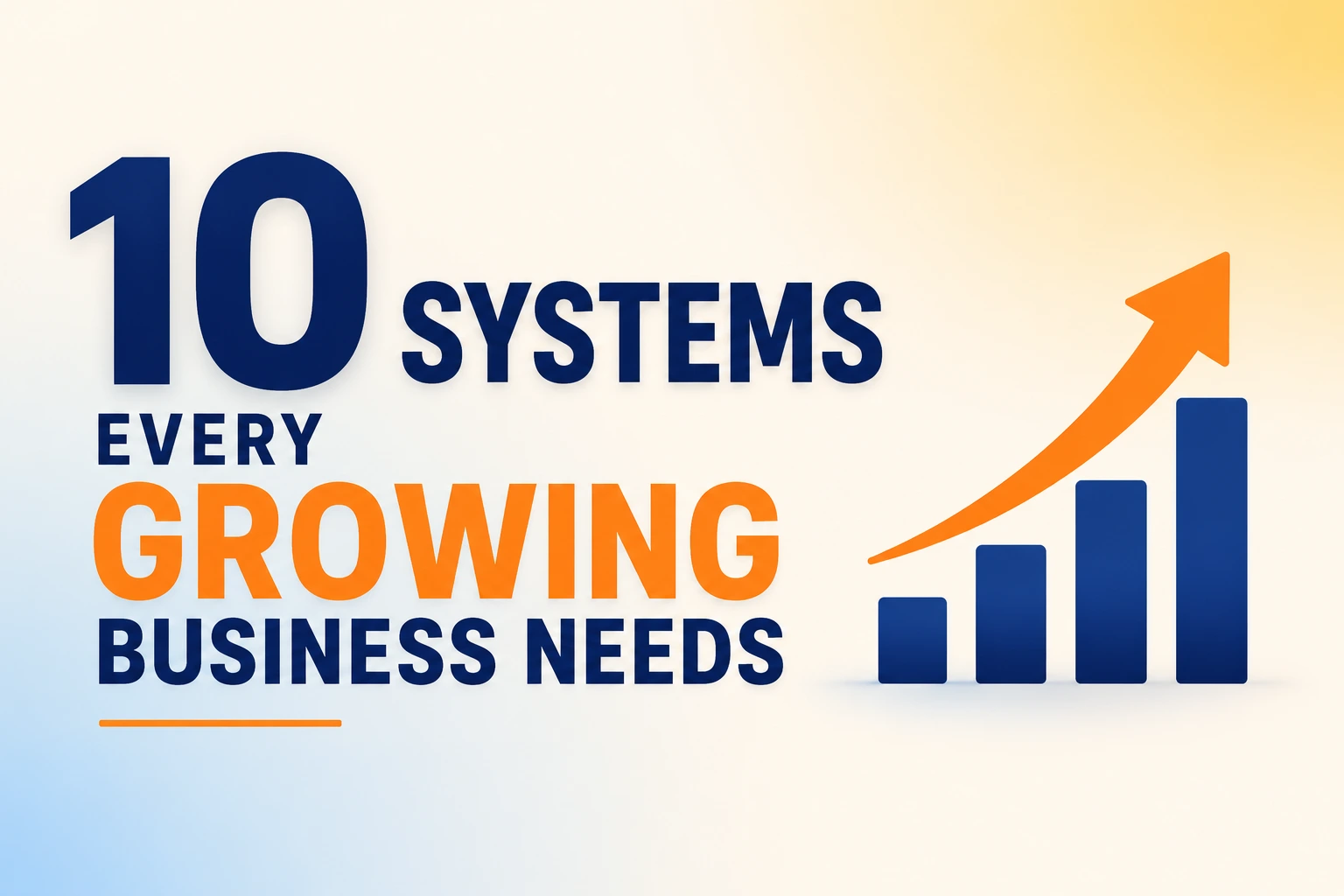
In this guide, we will explore the 10 systems every growing business needs to scale efficiently and sustainably.
What Are Business Systems?
Business systems are structured processes, tools, and workflows that help companies manage operations efficiently.
Instead of relying on manual coordination, business systems standardize operations and improve consistency. Before we list the 10 systems every growing business needs, it helps to understand what a business system actually is and why it matters.
Strong systems help businesses:
- Reduce operational errors
- Improve productivity
- Increase visibility
- Automate repetitive tasks
- Improve customer experience
- Scale efficiently
Without systems, businesses become overly dependent on people, manual effort, and reactive problem-solving.
Why Systems Matter for Business Growth?
As businesses grow, complexity increases rapidly.
More customers create more transactions. More employees create more communication challenges. More inventory creates more operational pressure.
Without systems:
- Teams become disorganized
- Data becomes inconsistent
- Operations slow down
- Customer experience suffers
- Decision-making becomes difficult
Systems create operational stability.
They allow businesses to grow without losing control. The classic Harvard Business Review study on the five stages of small-business growth reaches a similar conclusion. Below are the 10 systems every growing business needs to scale efficiently and maintain operational control.
1. Customer Relationship Management (CRM) System
A CRM system helps businesses manage leads, customers, sales pipelines, and communication.
Many growing businesses lose opportunities simply because customer information is disorganized.
Without a CRM system:
- Leads get lost
- Follow-ups become inconsistent
- Sales teams lack visibility
- Customer communication becomes fragmented
A centralized CRM helps businesses:
- Track leads efficiently
- Automate follow-ups
- Manage sales pipelines
- Improve customer retention
- Analyze customer behavior
CRM systems are essential for sales scalability.
Platforms like Odoo include integrated CRM modules that centralize customer management within the broader business ecosystem.
2. Inventory Management System
Inventory problems can silently damage business growth.
Growing businesses often struggle with:
- Overstocking
- Understocking
- Inventory mismatch
- Warehouse inefficiency
- Delayed stock updates
An inventory management system helps businesses maintain accurate stock visibility in real time.
Benefits include:
- Better stock control
- Faster fulfillment
- Reduced operational loss
- Improved warehouse efficiency
- Better purchase forecasting
This system is especially critical for:
- eCommerce businesses
- Retail companies
- Wholesale businesses
- Manufacturing companies
Integrated ERP solutions help automate inventory tracking and reduce manual dependency. Online retailers in particular benefit, as we explain in how Odoo ERP helps eCommerce businesses grow faster.
3. Accounting and Financial Management System
Cash flow is one of the most important parts of business scalability.
However, many growing businesses still rely heavily on manual accounting processes.
This creates problems such as:
- Delayed invoicing
- Weak financial visibility
- Expense tracking issues
- Tax management difficulties
- Inaccurate reporting
A financial management system helps businesses:
- Track income and expenses
- Generate invoices automatically
- Manage taxes
- Analyze profitability
- Improve financial forecasting
Strong financial systems improve decision-making and business stability.
4. Enterprise Resource Planning (ERP) System
As businesses grow, managing operations through disconnected tools becomes difficult.
This is where ERP systems become essential.
An ERP platform integrates multiple business functions into one centralized system.
ERP solutions like Odoo connect:
- CRM
- Inventory
- Accounting
- HR
- Purchasing
- Sales
- Manufacturing
- eCommerce
This creates:
- Better visibility
- Faster workflows
- Improved communication
- Data consistency
- Operational efficiency
ERP systems help businesses scale without operational chaos.
5. Workflow Automation System
Many businesses waste time on repetitive tasks.
Examples include:
- Manual reporting
- Invoice generation
- Customer follow-ups
- Data entry
- Approval workflows
Workflow automation systems eliminate repetitive operational tasks. Our guide to business process automation with Odoo shows how this works across departments.
Benefits include:
- Faster operations
- Reduced human error
- Improved productivity
- Lower operational costs
- Better process consistency
Automation allows businesses to scale operations without proportionally increasing workload.
6. Human Resource Management System (HRMS)
Managing employees becomes increasingly complex as businesses grow.
Without HR systems, businesses struggle with:
- Employee tracking
- Attendance management
- Payroll processing
- Performance monitoring
- Recruitment coordination
An HR management system helps streamline workforce operations.
Key benefits include:
- Automated payroll
- Attendance tracking
- Employee record management
- Recruitment workflows
- Performance evaluation
A strong HR system improves operational organization and employee management.
7. Project and Task Management System
Growing teams require structured collaboration.
Without proper task management systems:
- Projects become delayed
- Teams lose accountability
- Communication becomes confusing
- Deadlines are missed
Project management systems help businesses:
- Assign responsibilities
- Track progress
- Improve team coordination
- Monitor deadlines
- Increase accountability
Efficient collaboration becomes critical during business expansion.
8. Business Intelligence and Reporting System
Businesses cannot scale effectively without data visibility.
Many companies collect large amounts of data but fail to analyze it properly.
Business intelligence systems provide:
- Real-time dashboards
- Sales analytics
- Financial insights
- Operational performance tracking
- Customer behavior analysis
This improves strategic decision-making significantly.
Businesses that rely on data usually scale faster and operate more efficiently.
9. Communication and Collaboration System
As businesses grow, communication complexity increases rapidly.
Relying entirely on messaging apps often creates:
- Miscommunication
- Information loss
- Delayed coordination
- Workflow confusion
Businesses need structured communication systems for:
- Team collaboration
- Internal communication
- File sharing
- Department coordination
- Workflow transparency
Integrated communication improves operational alignment across departments.
10. Customer Support System
Customer experience becomes increasingly important during growth.
Without structured support systems:
- Customer issues get delayed
- Communication becomes inconsistent
- Customer satisfaction declines
A customer support system helps businesses:
- Track support tickets
- Manage communication
- Improve response times
- Maintain customer satisfaction
- Analyze service quality
Customer retention is one of the strongest drivers of long-term business growth.
Why Businesses Need Integrated Systems Instead of Separate Tools?
Many businesses use different software for different departments.
For example:
- Separate CRM software
- Standalone accounting tools
- Spreadsheet-based inventory tracking
- Messaging apps for communication
The problem is that disconnected systems create operational silos.
This leads to:
- Duplicate work
- Data inconsistency
- Communication gaps
- Slower workflows
Integrated ERP systems solve this by centralizing operations into one ecosystem.
This is why businesses increasingly adopt platforms like Odoo.
How Odoova Helps Businesses Build Scalable Systems?
Odoova helps businesses implement scalable operational systems tailored for long-term growth.
Instead of simply installing software, Odoova focuses on:
- Business workflow analysis
- ERP implementation
- Process automation
- Operational optimization
- System integration
- Scalability planning
The goal is to create connected systems that improve efficiency, visibility, and business scalability. Strong user adoption matters just as much as the technology, which is why Odoo training is essential for business success.
Common Mistakes Businesses Make Without Systems
| Mistake | Impact |
| Using spreadsheets for operations | Data inconsistency |
| Managing teams manually | Reduced productivity |
| No CRM system | Lost sales opportunities |
| Weak inventory tracking | Revenue loss |
| Delayed financial reporting | Poor decisions |
| No workflow automation | Operational inefficiency |
| Using disconnected software | Communication gaps |
| Poor customer support processes | Lower customer retention |
Signs Your Business Needs Better Systems
Your business may need stronger systems if:
- Teams constantly work overtime
- Inventory data is inaccurate
- Reports take too long to generate
- Communication feels disorganized
- Customer complaints are increasing
- Manual tasks consume excessive time
- Departments operate separately
- Business owners manage everything manually
These are signs that operational complexity is increasing faster than business systems can handle. Putting the 10 systems every growing business needs in place early prevents most of these problems.
Actionable Steps to Build Better Business Systems
1. Audit Existing Operations
Identify operational bottlenecks, repetitive tasks, and inefficiencies.
2. Centralize Data
Move away from disconnected spreadsheets and isolated tools.
3. Automate Repetitive Workflows
Focus on automating:
- Invoicing
- Reporting
- Inventory tracking
- Customer follow-ups
- Lead management
4. Improve Operational Visibility
Use dashboards and analytics for real-time insights.
5. Implement ERP Strategically
Choose scalable ERP platforms like Odoo with expert support from Odoova.
Frequently Asked Questions
1. Why are systems important for business growth?
Systems improve operational efficiency, reduce errors, automate workflows, and help businesses scale sustainably.
2. What is the most important system for a growing business?
An ERP system is one of the most important because it centralizes operations and integrates multiple business functions into one platform.
3. How does automation help businesses scale?
Automation reduces repetitive manual work, improves efficiency, and allows businesses to handle larger workloads without increasing operational complexity.
4. Is Odoo ERP suitable for growing businesses?
Yes. Odoo is highly flexible and scalable for businesses of different sizes and industries.
5. When should businesses implement ERP systems?
Businesses should implement ERP systems before operational complexity becomes difficult to manage.
Conclusion
Business growth without systems eventually creates operational chaos.
As businesses scale, complexity increases rapidly.
Without structured systems, companies struggle with:
- Communication
- Inventory management
- Financial visibility
- Workflow efficiency
- Customer management
- Operational control
The 10 systems every growing business needs — from CRM and inventory to ERP and automation — work together to create the operational foundation required for sustainable long-term growth. Businesses that scale successfully invest in them early.